このブログを検索

2020年3月31日火曜日

新型コロナウィルス:第3の波に備えて、日本は早めの行動制限を


昨年(2019年)冬に中国の湖北省武漢市で発生した新型コロナウィルスの感染は、その感染の拡大規模を、中国から世界全土へと広げていった。

筆者は、本年(2020年)127日から、日本文化チャンネル桜の「フロント・ジャパン桜」と言う番組で、この武漢肺炎、新型コロナウィルス(COVID-19)の感染症は、尋常ではない事態をもたらすと、ほぼ毎週月曜日ごとに警告してきた。昨日330日で、丁度2か月が経ち、様相は、想像以上に悪くなっていることを懸念している。毎日の感染者数や死者数は、日ごとに増えるばかりである。医療現場や、検疫所、保健所等の現場での必死の対応に感謝する。筆者は、自らの非力を感じながらも、2か月、自分なりに世界情勢を分析してきて、今回発見し、今後、日本が早急に取るべき対応について、以下、記しておきたい。

COVID-19始め、感染症の特徴は、人から人へうつすことで患者数が増えることである。そして、その人から人への感染は、人の移動によって急増し、また、国境を越えて莫大な広がりをみせる。今回の事例が、まさにグローバル化時代の怖さを語っているが、この2か月を見てきて、筆者は、今回の感染拡大の流れには、3つの波(段階)があることを発見した。第Ⅰ波は、1月末の春節の休みを利用した中国人の大移動であった。武漢から中国全土及び世界への移動がそれである。例えば、北海道の雪まつりに中国の団体観光客が訪れていたのも、この頃である。その人達から、世界の各地に新型コロナウィルスが広がり、それが発症してきたのが2月中旬以降の第2波と言えよう。その頃から、各国は国境を閉め始めたが、既に国内に感染者が多数いる。その人達の移動を介して感染がさらに拡大したのが3月で、第3の波と言えよう。すなわち、①武漢から中国や世界へ、②世界から世界へ、③国内から国内へ、と新型コロナウィルスの感染は拡大していった。

中国は、第1波で国境を閉め、国内移動を制限した。既に、第3波になっていたので、慌ててやった。そのため、多くの死者を出したが、国境封鎖と移動制限の効果が、そろそろ出て来た。

台湾は、第1波から第2波の段階で、早くに国境を閉め、国内では徹底した消毒と検温チェックを行い、感染拡大を、いまのところ抑えている。

欧州(EU)や米国は、日本より早めに第2波で外側の国境を閉め始めたが、中の移動は制限していなかったので、そこでの感染が拡大した。そして、今、第3段階で、国内、市内の移動制限をしている国もあるが、それまでの患者数が多いので、医療崩壊をしてしまった所は、死者が増えている。イタリアでは3週間以上の都市封鎖、英国では2週間以上の都市封鎖を実行し、多少の効果が出て来たと、ロイターで報道されていた。

さて、日本の場合はどうか。現在は、第2波から第3波の過程にあると言えよう。国境を閉じるのも遅く、移動制限もないままで、今後が心配である。一般国民11人の衛生観念や健康意識が高いので、マスク、手洗い、うがい等で感染の急拡大を防げていた点はあるにしても、先進諸国で国境を完全には閉鎖せず、移動制限もない数少ない国として、まだ感染者が入国し、さらに国内でも感染も広がる危険がある。多くの日本企業は、既に自宅勤務(テレワーク)等を実施しているが、政府が早めにある程度の移動制限をしないと、感染は止まらないだろう。他国が収束傾向にある時期に、日本が医療崩壊しかねない可能性さえある。なお、最近の世界全体の状況を見ると、今まで感染者数が少なかったアジア、アフリカ、中南米等の諸国でも、感染が増えている。この点も気になるところであり、早め早めの入国制限が必要だろう。来年のオリンピック・パラリンピック開催国としても、日本の対応は、世界が注目するところとなる。

参考:世界のCOVID-19感染者数等 https://www.worldometers.info/coronavirus/


2020年3月20日金曜日

The Tokyo Olympics should be postponed, but not cancelled.


My book entitled 'The Olympics and the Japanese Sprit' (a new version) translated by Dr. Robert Eldridge and his colleague was published.

In this difficult time, the survival of human beings is based on cooperation, peace, solidarity, and love. The life of individuals is the most important. My motivation to write this book is coming from this concept.

The Tokyo Olympics should be postponed, considering the present world situation affected by the COVID-19. 
But it should not be cancelled, because for the athletes who are preparing hard for the Tokyo Olympics.
Anyway, what I wanted to say in the book does not change, in any case, it is a hope for the future.
Please enjoy reading it. 

The Olympics and the Japanese Spirit

2020年3月19日木曜日

What Human beings can learn from the COVID-19.

  In 2015, Former CEO of the Microsoft, Mr. Bill Gates said that we invested much in nuclear weapons but we have to invest more to prepare the anti-virus which could spread to world cities through people appearing in a good health. What we are now expiring vis-à-vis COViD-19, originated from Hunan, China and proliferated to all over the world  is just what Bill Gates predicted.
 (See the following site : https://www.ted.com/talks/bill_gates_the_next_outbreak_we_re_not_ready?utm_source=tedcomshare&utm_medium=email&utm_campaign=tedspread)

  It reminds me what Dr. Taro Nakayama, a Medical Doctor, and Former Foreign Minister of Japan, Founder of the IMPO (International Medical Parliamentarians Organization), non-profit-organization associated with the WHO, said, watching at people walking at streets.
 'If the human beings may be perished, it would not by the nuclear wars, but by any virus which we can not see.

 The threat we can not see might be more dangerous than the threat we can see.
But why can we, human beings survive on this earth, without having strong tusks or fangs,  spines or thorns, without having huge bodies like elephants or dinosaurs. It's because we have
a wisdom, but also the survival of human beings is based on cooperation, solidarity, benevolence and love. In Japan, 'Omoiyari' (Thinking of others) and 'Tasukeai'(Helping each other) are high valued virtue, because people living in Japanese archipelago are always facing natural disasters like volcano
explosions, typhoons, earthquakes,, etc. If people do not help each other, they can not survive.

 On February 1, 2020, when the COVID-19 from Huan, China already penetrated in Japan, I was participating in an international event on 'Tokyo 2020, sport without borders'. It is true that in the Olympics, regardless of race, culture, languages, etc. people can be friends, through fair play competitions.
  We have been opening the borders and welcoming the outsiders, which promote the dynamism and diversity of a country. But this COVID-19 without borders became a world threat and it coming into the every corner of the world as a no-seen killer monster. Many countries shut suddenly the borders and asked people to stay home or close their shops. It is something totally contrary to the globalization. We considered that the life of individuals is the most important, and the national-border is the best way to protect people's lives.

 What have we learnt from this experience? One is that the life is more important than economy. It is said that money can buy a house, but not a home, money can buy food, but not appetite, money can  buy goods, but not love and respect. Too much globalization for economy put the world in a greater risk. The second is that we need a nation to protect ourselves, our identity, our culture, our history and our lives. It is not a contradiction to the internationalization. If you see the Olympics, people respect each other, each nation, each identity. That means the respect of the diversity.

  If we respect each other and help each other, we will overcome this difficult time.

 日本語では、下記のネットン番組(65分~75分位)で、「人類が新型コロナウィルスから学ぶべきこと」について簡単にお話しております。


2020年2月16日日曜日

新型コロナウィルスと中国、そして日本の危機管理?

2020年2月15日現在、日本でも新コロナウィルスによる死者が出てしまい、中国内でも日本人がお亡くなりになりました。日本国内の感染者も3桁になってしまいました。
米国は、チャーター機で、自国民の救出をするために、日本にやってきます。すなわち、中国と同様に、日本(横浜停泊のダイヤモンド・プリンセス)に自国民をおいていては命を救うことはできないと判断したわけです。
 1月27日の放送で、すでに私は、新コロナウィルスに関する日本の危機管理に警笛を鳴らしました。全く聞いてもらえず、事態は悪化しました。
 今でも都内あちらこちらで、中国からの旅行者が元気に遊んでいるそうです。
 一方、日本の地方(和歌山県)の病院では外科医の方が複数、感染されたそうです。大切な医療関係者が、中国発の感染症にかかってしまったこと、とても遺憾に思います。
 旅行者のみではありません。あまりに急激なコントロールのきかない人々を日本に入れすぎてしまった安易な政策は考え直すべきでしょう。そうでないと、日本政府が日本人を助けるどころか、犠牲にしてしまうことになりかねません。
 以下、3週間連続で、数字を挙げながら、海外の情報も参考に、現実的にお話し致しました。


2020年1月1日水曜日

謹賀新年 令和2年元旦

 令和の御代に入り、初めてのお正月。
 あけましておめでとうございます。
 2020年は、いよいよ東京オリンピックの年。

 鈴木くにこ著『オリンピックと日本人の心』(内外出版)は、増刷(3刷)が決まり、私のお誕生日1月13日付の出版となる予定です。
 また、英語版"The Olympics and the Japanese Spirit"も、まずは電子書籍で発売されます。
 その題字を、書家の渡邉麗先生に書いて頂きました。


 先生についえ、あとがきに、次のように述べました。実際に英訳されて発表されます。

[英語版表紙の題字について]
 美しく力強く、そして動きのある題字”The Olympics and the Japanese Spirit”。書家の渡邉麗先生に書いて頂いた。渡邉麗先生は、2019年(令和元年)産経国際書展にて、栄誉ある最高賞「高円宮賞」を受賞された。書の大家、國井誠海先生の後を継がれ、誠心社の会長を務めていらっしゃる。まさか、このような書の大家の先生に、拙著英語版の表紙を飾って頂けるとは思ってもみなかった。心から深く感謝申し上げる。
 先生が「高円宮賞」を受賞された作品「氣淑く風和らぐ」は、新しい御代「令和」の語源となった万葉集から引用されたものだ。それについて、先生は、「人々が美しい心で文化が生まれ育つ国であるように」という意味合いに感銘された、と述べられている。[i]
 はっとさせられた。本書『オリンピックと日本人の心』の冒頭で、筆者は、本書は一種の日本文化論であるが、それは独善的なものではなく、世界の文化ともつながりがあるかもしれないと述べた。そして、オリンピズムが人生の哲学そのものであり、オリンピックが、創設者クベルタン男爵が目指したように、人間性を高める機会だとすると、その理想は、「美しい心」を持つ人達が築く文化国家の発展なのかもしれない。そんなことを思うと、一流の文化国家であり続けたいフランスから、近代オリンピックが生まれたのも不思議ではないのかもしれない。
 渡邉麗先生は、また、「芸術とは人間そのものであり、」「日々刻々と移り変わる自分の『いのち』を見つめ、表現し、純粋な自己の証しを印すことです。」と述べ、「それは人間の心の奥底でつながり、何ものにもとらわれぬ万人の普遍的共感を呼びさますこととなります。」とおっしゃる。[ii]芸術しかり、スポーツしかり。日々生きていることを刻み、自己表現しながら、人々に感動を与えることがある。何故、オリンピックの競技は、人々に感動や勇気を与えるのだろうか。それは、そこに「いのち」の存在と表現があるからだろう。本書を通じて伝えたかったのも、人の「いのち」と「心」の物語である。
 渡邉麗先生とのご縁を下さったRobert D.Eldridge先生とAlain Roy氏にも感謝する。
 “The Olympics and the Japanese Spirit”――渡邉麗先生の題字は、既にオリンピックの競技が始まって動き出しているように見える。陸上か水泳か、それとも...。皆が元氣に走っている。そんな戯れが聴こえてきそうである。


[i] 産経国際書会「会報」(20199月号第94号)9頁。
[ii] 現代書の研究誌『誠心』(201912月号)1頁。


2019年12月6日金曜日

What is Zen?

I participated in a special Zen experience which is held during the first week of December.
Why this period of the year? Because, the Buddha opened his enlightenment on December 8th, after 8 days of Zen (sitting meditation) under the linden tree.
 I was a very beginner of this Zen experience, and a Monk taught me ow to practice Zen.
 There are 3 points:
(1) Set up your body (straight in a good sitting position).
(2)Set up your breathing (10 seconds of breathing our and 5 seconds of  breathing in, you will do it 4 times in one minute)
(3)Set up your mind or spirit (that is the most difficult, a Monk said. You look 45 degree below, and try to hear nothing, but if it's difficult, you may close your eyes and imagine a river on which a leaf is going away. You will put all your idle and evil thoughts on that leaf. You will need any power because it goes naturally with the leaf on the river).

After experiencing this Zen for 40 minutes, I felt very healthy both with my body and mind. It is like a purification of both.

Zen is just sit, sit sitting without thinking anything, it is a meditation.
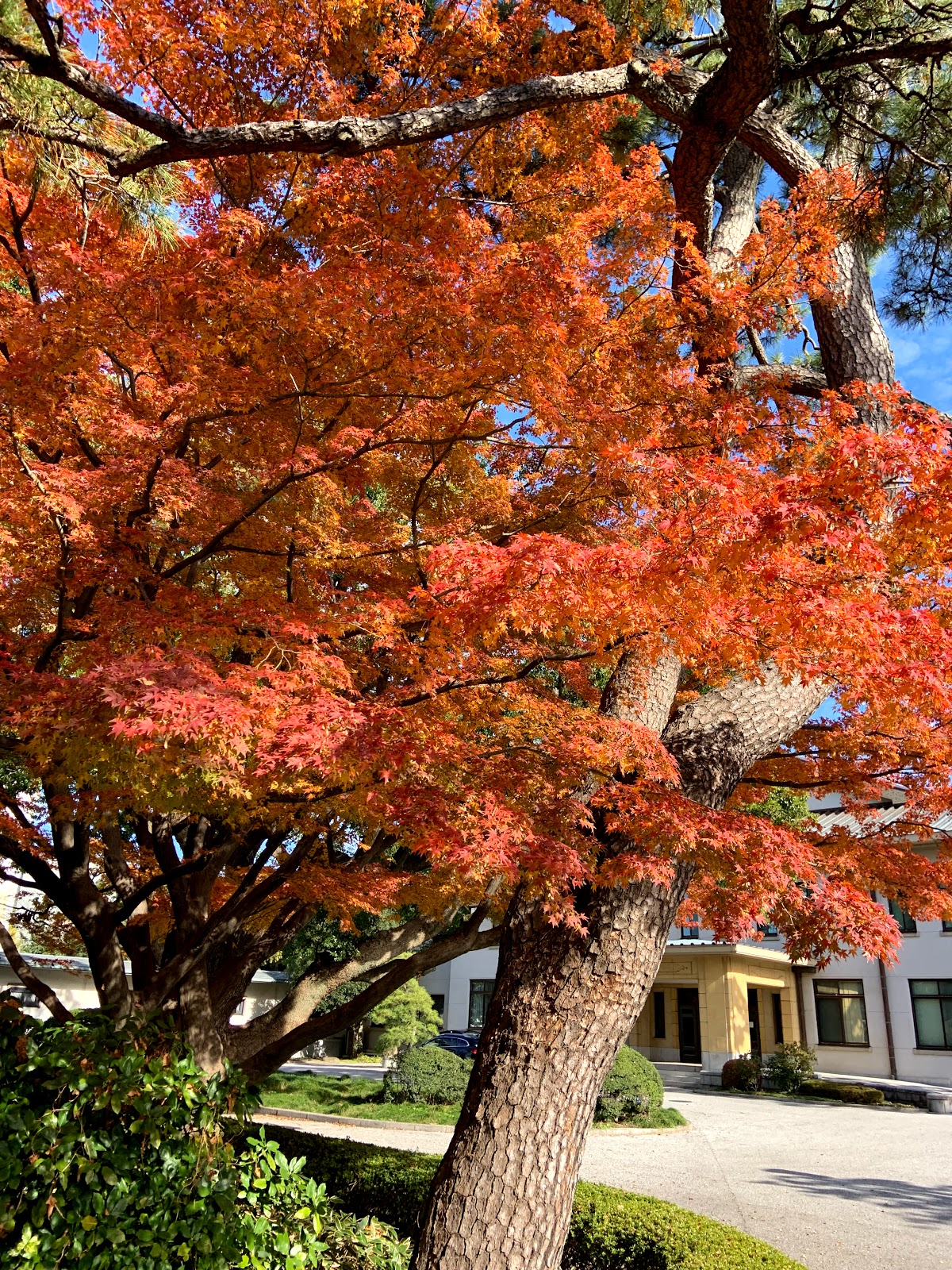
Another Monk said to us, "You can sit like a big tree in a garden." A big tree has many branches and leaves, it has long and tough roots. People come to gather under a big tree.
Experiencing the Zen, you can become like a big tree in a garden!


禅とは?「庭前柏樹子」


令和元年(2019年)12月5日、早朝座禅会に参加した。

 お釈迦様が12月の8日間、菩提樹の下で坐禅をして悟りを開いたことから、「臘八摂心(ろうはつせっしん)」という座禅会があり、その1日を体験した。

 40分の坐禅の最中、耳にしたのが「庭前柏樹子(ていぜんのはくじゅし)」のお話。


庭に生える1本の大木、樫木でも、杉でも松でも良い。大全として、枝葉を伸ばし、根を深く張る。ただそこにあるだけで、人々が憩いを求めて集い、戯れる。そんな大木の1本になって、ただひたする座る。

 そんな気持ちで坐禅を組んでいたが、入門者の私はすぐ見破られてしまった。僧侶の方が静かに私に寄って来られ、坐禅の仕方を教えて下さった。要点は3つ。

(1)姿勢を整える(足を組んでも正座でも良い)。

(2)呼吸を整える(10秒吐いて5秒吸う。それを4回繰り返して1分)。

(3)心を整える(45度下を見つめ何も音を聞かない。出来なければ目を瞑り川を想像しながら、そこに木の葉が1枚流れて行く上に雑念を置いて行く。自然と雑念は流れて行くので力は要らない)。→「これが一番難しいですね。」と言われる。


何だか、私の心の汚れが分かってしまったようで恥ずかしかった。でも、初めての「臘八摂心」の後、心身ともに清々しかった。

 ゴマと梅干の御粥をご馳走になり、その足で、皇居に向かった。

 日本の五穀豊穣を願い、お祈りし、

天皇陛下が神様とともにお供え物を召し上がった大嘗祭が執り行われた大嘗宮。

 青空の下、その神聖なる建物を拝観し、日本の豊かな恵みにただ感謝した。

令和元年師走 鈴木くにこ